
Founder of Bike Sense
PD van der Westhuizen
Founder of Bike Sense · Creator of the patented The Nose · Hayabusa developer and aerodynamic fabricator
His story
The Physics of Extreme Velocity: PD van der Westhuizen and the 437 km/h South African Hayabusa Project
Introduction
In the world of ultra-high-performance motorcycling, the Suzuki Hayabusa stands as an icon of raw speed. However, pushing a motorcycle past its factory boundaries into the realm of 400+ km/h requires shifting from traditional mechanical tuning into pure aerospace engineering.
In South Africa’s elite land-speed and high-speed testing circles, PD van der Westhuizen has carved out a reputation as both a multi-generational Hayabusa developer and a specialized aerodynamic fabricator.
Most notably, his custom bodywork engineering contributed to the legendary 1999 Generation 1 copper/gold Hayabusa turbo project (piloted and developed alongside Wouter Labuschagne and Lourens Visser), which achieved an unofficial test top speed of 437 km/h and multiple officially clocked runs exceeding 401 km/h and 435 km/h on a 4-kilometer high-altitude stretch outside Johannesburg.
The Ultimate Fleet: Multi-Generational Engineering
To understand the engineering evolution, we must analyze the three distinct eras of the Hayabusa platform that PD modifies and tests on flat-road conditions.
| Machine Generation | Displaced Volume & Induction | Electronic Framework | PD’s GPS-Verified Top Speed | Engine & Tuning Architecture |
|---|---|---|---|---|
| Generation 1 (1999–2007) |
1,299 cc Naturally Aspirated / Turbo |
Unrestricted 16-bit ECU (1999–2000) | Baseline Platform | The “unrestricted” analog foundation. Raw mechanical potential without electronic throttle intervention or factory speed-limiting algorithms. |
| Generation 2 (2008–2020) |
1,340 cc Forced Induction (Turbo) |
32-bit ECU / Factory 299 km/h Limit | 360 km/h | Heavy mechanical modification coupled with ECU programming to override the 300 km/h Gentlemen’s Agreement. Requires high-volume fuel delivery systems to sustain extreme turbo boost. |
| Generation 3 (2022–Present) |
1,340 cc Naturally Aspirated / Tuned |
CAN-bus / Ride-by-Wire / Restrictive ECU | 346 km/h | Advanced electronic interfacing. Achieving 346 km/h requires sophisticated ECU flashing to completely rewrite electronic throttle valve maps and speed-sensor overrides. |
On smaller screens, swipe the table sideways to see every column.
The Aerodynamics of 437 km/h: Formulas and Fluid Dynamics
When a motorcycle accelerates from 100 km/h to 400 km/h, the engine does not encounter a linear increase in resistance; it encounters an exponential fluid wall.
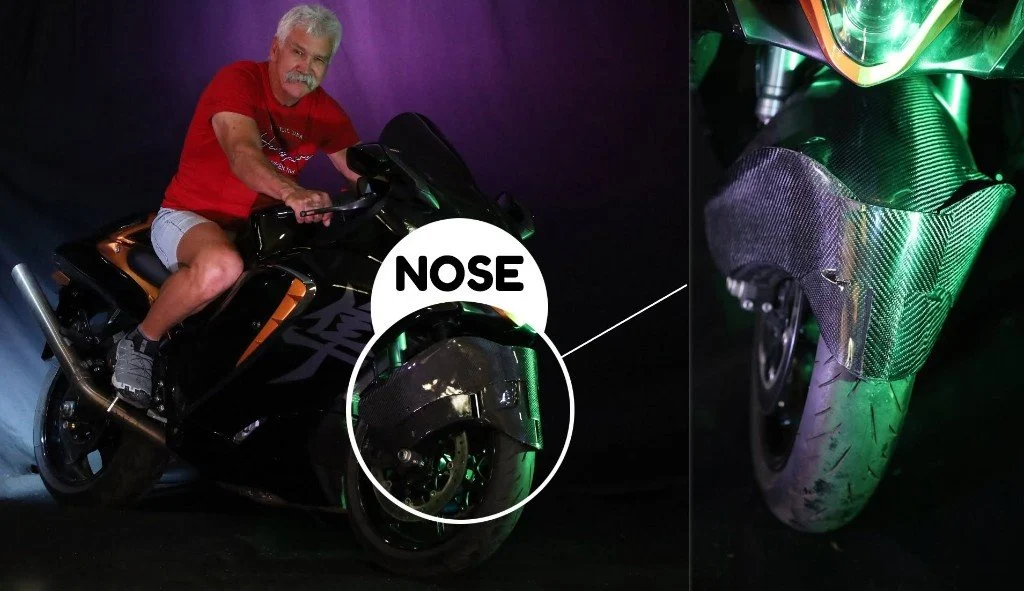
PD van der Westhuizen’s crucial role in the 437 km/h project focused directly on this barrier: fabricating the front nose cone assembly and custom front mudguard.
To appreciate why this fabrication was critical, we must evaluate the core governing equations of high-speed fluid dynamics.
1. The Aerodynamic Drag Equation
The total aerodynamic resistive force (Fd) opposing the forward motion of the motorcycle is expressed by the classic fluid dynamics equation:
Where:
- ρ (Rho) = Atmospheric air density (approx. 1.204 kg/m³ at sea level, but lower at Johannesburg’s high altitude, approx. 1.01 kg/m³, which marginally aids top speed but starves un-boosted engines of oxygen).
- v = Forward velocity of the vehicle (m/s).
- Cd = Coefficient of drag (a dimensionless index of how slippery the vehicle shape is).
- A = Frontal surface area (m2).
2. The Exponential Power Trap
The power (P) required to overcome this aerodynamic drag is the product of the drag force and velocity (P = Fd · v), leading to the cubic power equation:
Because velocity is cubed (v3), doubling your speed requires eight times (23) the power.
3. Mitigating the Lift Coefficient (Cl)
As air rams into the front fairing of a standard motorcycle, it naturally flows up and over the windscreen, creating a localized low-pressure zone directly above the rider and front tank. By Bernoulli’s principle, this pressure differential generates aerodynamic lift (Fl):
At speeds exceeding 350 km/h, uncontrolled lift can lighten the front tire to the point of a catastrophic tank-slapper or complete loss of steering friction.
PD’s nose assembly and mudguard
PD’s custom fabrication of the nose assembly and mudguard altered the front stagnation point (where air velocity drops to zero and pressure maximizes). By extending the nose and profiling the mudguard to hug the front wheel tightly, the design minimized the volume of air trapped underneath the nose. This forced a high-pressure gradient over the top of the mudguard, converting lift into functional downforce, keeping the front wheel firmly planted on the tarmac at 437 km/h.
Patented by Bike Sense
The Nose
PD van der Westhuizen is the founder of Bike Sense and the creator and innovator of The Nose. His years of hands-on work with superbikes led to the aerodynamic design behind it. The Nose is Bike Sense’s patented aerodynamic design for superbikes. It reduces drag and slipstream for more top speed, quicker acceleration and better fuel consumption.
The Nose: a product for the Suzuki Hayabusa (and more motorcycles) to make it faster at top speed.
The Mechanical Backing: Severe-Duty Lubrication Blueprint
Aerodynamics keep the bike stable, but mechanical preservation keeps the engine from detonating under the intense heat generated by forced induction. For these extreme velocity environments, PD van der Westhuizen implements a strict Motul 10w60 synthetic lubrication protocol, deviating heavily from the OEM factory-recommended 10w40 weight.
The Thermal and Kinetic Physics of 10w60 Oil:
Summary of the Technical Blueprint
Achieving ultra-high speeds on a motorcycle is a symbiotic balancing act between three disciplines:
Recognition
Accolades & press
More on PD’s achievements coming soon.
Talk to Bike Sense
Questions about Hayabusa performance, aerodynamics or The Nose? Chat to us on WhatsApp or email.
WhatsApp 079 231 2573info@bikesense.co.za
Open every day 08:00–16:00 · 208 Howard Street, Pretoria 0182